My Colorist Finally Told Me the Truth About Why My Color Keeps Fading. Then She Said Something I Never Expected. (She Told Me to Change My Showerhead Before My Next Appointment)


 6711
6711 35
35


Free Shipping | 60-Day Returns
My Colorist Finally Told Me the Truth About Why My Color Keeps Fading. Then She Said Something I Never Expected. (She Told Me to Change My Showerhead Before My Next Appointment)
671135
A quiet warning for every woman who has ever left the salon loving her color and watched it turn brassy, flat, or dull in less than three weeks. Read this before your next appointment.
I have been coloring my hair for eleven years.
Balayage. Highlights. A brief and regrettable auburn phase. And for the past three years, a full custom blonde that I am genuinely embarrassed to tell you how much costs per session.
The problem was never the color going in.
The problem was how fast it left.
Within two weeks of every appointment, my blonde looked like someone had run a yellow filter over a photograph.
Brassy. Flat. Nothing like what I left the salon with.
I blamed everything. The shampoo I was using. The sun. The fact that I showered in the morning and my colorist had told me not to wash my hair for forty-eight hours after. (I lasted eighteen.)
I switched to purple shampoo. Then to a color-depositing conditioner. Then to a shampoo that cost forty-two dollars a bottle and arrived in packaging that looked like a luxury hotel amenity.
Nothing extended the life of my color beyond three weeks.
Nothing.
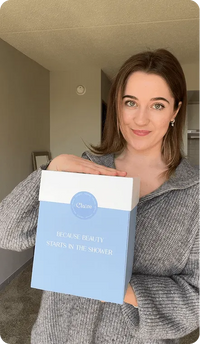

"Most of my clients blame their shampoo. I stopped letting them leave without asking one question first: what does your shower water smell like? If the answer is chlorine, the shampoo was never the problem."
My colorist of seven years, Sarah Jenkins, said that to me on a Tuesday afternoon in March.
And I stared at her for a moment, genuinely confused.
She had never said anything like that before. In seven years. She had recommended toning shampoos. She had told me to turn the shower cooler after washing my hair. She had recommended a gloss treatment that bought me an extra two weeks last autumn.
But she had never said anything about the water itself.
I asked her why she was telling me this now.
"Because I finally found something that actually works," she said. "And I have been using it for six months with my clients and I can see the difference in their results."

Municipal water, the water coming out of your showerhead right now, is treated with chlorine.
In some cities, chloramine. A combination of chlorine and ammonia that is harder to remove and stays in the water longer.
The reason is simple: it kills bacteria. It keeps the water safe from the treatment plant to your tap. That is what it is designed to do.
The problem is that chlorine does not stop being an oxidizer once it reaches your shower.
It keeps oxidizing whatever it touches. Including your hair color.
The process that strips the melanin from your hair during a bleach or color service is an oxidation reaction. Chlorine runs the same reaction, slowly, on your color, every single morning.
Every time you shower, the chlorine in the water is chemically attacking the pigment molecules in your hair. Breaking them apart. Washing them down the drain.
Purple shampoo replaces some of what is lost. But you are losing color every single day, with every shower, whether or not you shampoo.
You are trying to refill a bucket that has a hole in the bottom.
What Sarah told me that I could not stop thinking about: The EPA permits up to 4 parts per million of chlorine in tap water. That is the same concentration used in some public swimming pools. Every morning shower is a ten-minute chlorine soak on freshly colored hair.


Sarah said she had recommended shower filters to clients before and mostly stopped because they did not work well enough to change results noticeably.
"The issue is contact time," she told me. "Water moves through a shower at two gallons per minute. Most filters use slow-reacting materials. By the time the water passes through, nothing has happened."
She had started recommending one specific filter six months earlier, after a coworker in New York mentioned clients who were keeping their color significantly longer. She tried it herself first. Then she recommended it to three clients whose color she could track closely over time.
"The results were different enough that I changed my intake process," she said. "I now ask every new client about their shower water before I quote a maintenance schedule."
The filter she recommended is called Claire.
It uses two materials stacked together. Both are chosen for how fast they react at shower flow speed.

KDF-55 : a blend of copper and zinc that reacts with chlorine on contact and pulls heavy metals from the water. Fast-reacting by design. Built for the short contact window of a shower.
Calcium Sulfite : handles what most carbon filters cannot. Specifically effective in hot water, which is where the majority of chlorine-reduction failures happen. Hot water moves faster and carbon breaks down in it.
16 filtration stages : in sequence, including activated carbon and mineral media, so the water reaches your hair with significantly less chlorine and fewer harsh minerals than it started with.
Full water pressure maintained. The filtration process does not reduce flow. You get the same pressure with a fraction of the chlorine.
Installs in under five minutes on any standard shower arm. No plumber. No tools beyond the wrench included in the box.

I installed it the same evening Sarah told me about it. It took four minutes.
The first shower was not dramatically different. The water felt similar. The pressure was identical. But the faint chemical smell I had always assumed was just what water smelled like was gone.
That alone was worth something to me.
By the end of the first week, my hair felt lighter somehow. Less coated. Like a layer of something I had never named had been washed off and was not being replaced.
By the end of the third week, I had not reached for my purple shampoo once.
My hair was not brassy.
I was two weeks past what had historically been the outer limit of my color looking fresh. My blonde still looked like I had left the salon recently. It was tonal. It was reflective. It was not dingy.
At my next appointment, Sarah looked at my roots and asked what I had done differently.
"Nothing," I said. "Except the showerhead."
She nodded. She had heard that before.
"I tell my blonde and vivid-color clients now: I can add six weeks to your color life without touching your formula. Change your shower water. That is all it takes."

Why Claire Exists
Claire Matthews did not build this company because she saw a market opportunity. She built it because she spent years watching her own color fade, her skin dry out, and her hair break, despite trying every product on the shelf.
"No cream or conditioner was ever going to work if I was rinsing with chemicals every day. I built Claire to fix the real issue, not mask it."


 Removes chlorine and inhibits heavy metals using KDF-55 and calcium sulfite, the two materials that react at real shower speed
Protects your color investment by stopping daily oxidation damage between salon visits
Screws onto any standard American shower arm in under five minutes. No tools. No plumber.
Renter-friendly. Remove it when you move out. Landlord never has to know.
Keeps full water pressure. Filtration does not mean weaker flow.
Backed by a 60-day home trial. Send it back if your color does not last longer.
Removes chlorine and inhibits heavy metals using KDF-55 and calcium sulfite, the two materials that react at real shower speed
Protects your color investment by stopping daily oxidation damage between salon visits
Screws onto any standard American shower arm in under five minutes. No tools. No plumber.
Renter-friendly. Remove it when you move out. Landlord never has to know.
Keeps full water pressure. Filtration does not mean weaker flow.
Backed by a 60-day home trial. Send it back if your color does not last longer.
 High pressureUniversal fitEasy installReplaceable filterFree shipping60-day guarantee
